A version of this blog post appeared in the Main Line Genealogy Club’s online newsletter, The Dispatch 3.5 January 2024
December 16, 2023 was the 250th anniversary of the famed Boston Tea Party. There were countless events leading up to and on the anniversary, mostly in Boston, but also around the world. These events were just a prelude of things to come as we celebrate the semiquincentennial of birth of the United States of America. I am proud to say that my fourth great-grandfather, Joseph Roby, had a small part to play in the founding of this country, including as a participant in the Boston Tea Party.
I grew up knowing that my paternal roots in this country went way back to New England, including to the Mayflower. I also knew that the Robys were emigrants from England to the Boston area in the mid-1600s. While I never heard any specific stories, the family story came down through the generations that my fourth great-grandfather, Joseph Roby (1753-1836), participated in the Boston Tea Party and fought in the Revolutionary War.
It was not until I was in a colonial American history class in college that I revisited my revolutionary ancestor. Dr. Dan Rolph, who was the reference librarian for the Historical Society of Pennsylvania (HSP) for many years, was my professor. He introduced me to manuscripts at HSP, including a letter written by my fifth great-grandfather, Joseph Roby (yes, another one), which was in their archives. He also showed me sources on the tea party and colonial America. Later, I went to the National Archives branch in Philadelphia, used microfilm for the first time, and found Joseph Roby’s service record from the Revolutionary War.
Over the years as I have become a better genealogist, I have delved deeper into Joseph Roby. One of my main research goals is to prove (or disprove) that he participated in the tea party. I contacted the Boston Tea Party Ships & Museum early this year because I saw that they had a brand-new descendants program, in partnership with the New England Historic Genealogical Society (NEHGS). I have not completed my application yet, but I do plan on it if I can confirm my ancestor’s involvement. The museum and NEHGS have concluded that Joseph Roby was a participant, but the genealogist in me needs to continue the reasonably exhaustive research.
There are only two documents which list Joseph Roby as a participant in the Boston Tea Party: an 1819 letter printed in the Niles Weekly Register and the book Tea Leaves: Being a Collection of Letters and Documents Relating to the Shipment of Tea to the American Colonies in 1773 By the East India Company by Francis S. Drake. The 1819 letter was written by Lewis R. M. Morse, a son of Anthony Morse. Lewis claims that his father and Joseph Roby “were the most active in destroying the tea.” He wrote the letter on June 22, 1819 from Hanover, New Hampshire, and states that Joseph Roby was currently living in that town. My ancestor’s whereabouts have been hard to trace, but he probably resided in Hanover, NH at that time. He ended up near Rochester, New York by the 1830s.
Tea Leaves was published in 1884. The first part of the book lists Boston Tea Party participants and what, if anything, is known about them. This is the entry for Joseph Roby on page CLIV (p. 154): “Resided in Prince Street, Boston, in 1807, but was living in Hanover, N.H., in 1817.” There are no citations for this information nor in any other entry. However, as documented in his Revolutionary War pension file, a few people testified that Joseph Roby lived in Hanover, NH around 1817–1819. The Prince Street address can also be confirmed by newspaper advertisements and other records.
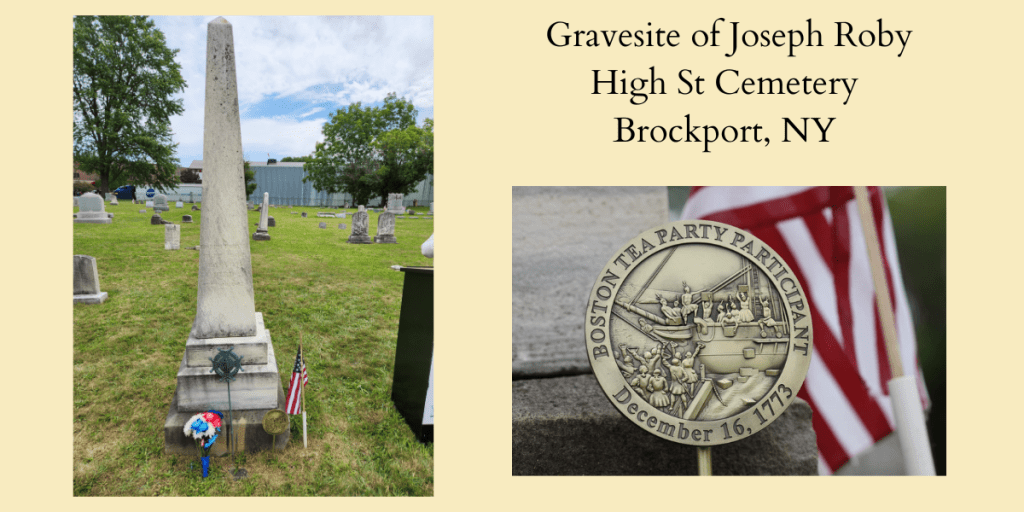
I was shocked in June 2023 to receive an email from my contact at the Boston Tea Party Ships & Museum. She said their group located many burial locations for Boston Tea Party participants, and they were placing markers on their graves throughout the rest of 2023 leading up to the anniversary. My ancestor’s grave is in Brockport, New York, over four hundred miles away from Boston. I could not pass up the opportunity to represent my family at this event.
On July 10, 2023, representatives from the Boston Tea Party Ships & Museum, Revolution 250, the towns of Brockport and Sweden, New York, and the local DAR and SAR chapters honored my fourth great-grandfather. It was a small, but nice ceremony and one which I won’t soon forget. I also felt drawn to attend because my grandfather, who was the first person to tell me about my family history, was instrumental in organizing a similar ceremony fifty years prior in 1973 on the 200th Anniversary of the Boston Tea Party.
Dec 16, 1973 (200th Anniversary of the Boston Tea Party) – My grandfather, Rochester Ross Roby, took this photo at an event to honor our ancestor, very similar to the one I attended almost 50 years later.
I intend to keep researching Joseph Roby. I have been working on an article which I hope one of the major genealogical journals will publish. The focus is how I sorted out my Joseph Roby from all the other same named individuals in the Boston area. I was able to spend three extra days in Brockport and Rochester during my trip in July researching in local archives. Some of the information I uncovered should help with that future article. One of my resolutions for 2024 is to write more often on this blog, so if you want to read more about Joseph and my research, please sign up to receive updates.
Are you researching any of the same people, names, or places I am for The Enslaved at Oakley & Beyond Project? Look at the surnames below. Contact me if you think you are connected.
During the Q&A at a recent presentation I gave on my research project, The Enslaved at Oakley & Beyond Project, I received a recommendation to help me with my research. The person suggested that I post a list of the surnames I’m researching on my blog and anywhere else where people can find it. I thought it was a great idea! So that’s what this post will be. I’ll make a note if there is an enslaver’s surname and if the surname appears somewhere outside of Northern Virginia and Washington, D.C., such as Montclair, Essex County, New Jersey.
Please reach out to me if you think you are related or connected to a name or place below. Click on the Contact tab at the top of the page and send me a message. I will do my best to respond to you as soon as possible.
* = Enslaver (may also be name of enslaved persons)
That question has been on my mind all day. As someone whose DNA is 100% European, most people may think, “not much.” For people who follow this blog and know the research I have been focused on for the last few years, I bet the answer is different. When I think about Juneteenth in 2023, I think of family.
I’m not going to pretend that I know everything about the history, culture, and everything else that is Juneteenth. However, I do know that the institution of slavery and the people behind it tore families apart. I see Juneteenth as a celebration of reuniting families, especially after the Emancipation Proclamation, the events on June 19, 1865, in Texas.[1]and the 13th Amendment.
Last Friday night, sometime after midnight or 1am, I came across some marriage records in the Freedmen’s Bureau.[2] I had not seen these before, but I realized right away that these were special.
On Friday evenings, I go on Zoom with a few dozen other like-minded individuals, who are researching African Americans, to learn about the Freedmen’s Bureau. Not only do we learn, but we also have a great time. Dr. Shelley Murphy has been volunteering her Friday nights to lead the group for about 18 months now. I believe the group began as an offshoot from the MAAGI[3] in 2021. The Friday night event is called Freedmen’s Bureau Fridays.[4] These Zoom sessions can last well into Saturday morning.
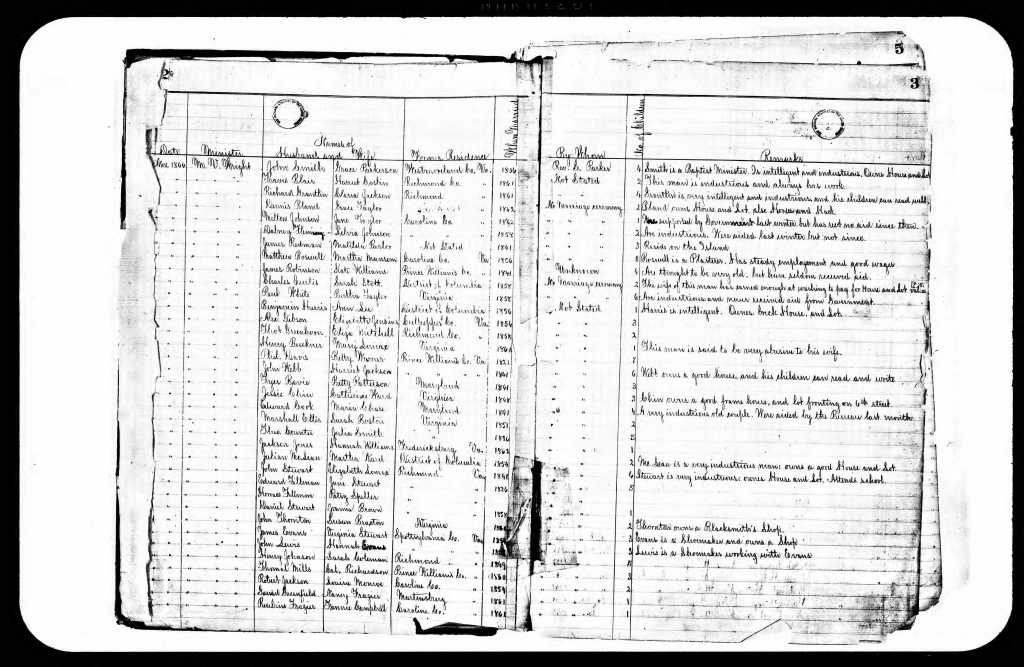
It was like this last Friday/early Saturday when I discovered the marriage records. I didn’t make the connection until during the day today between the people listed in those marriage records and the Juneteenth holiday. The records are perfect examples of the reuniting of families upended by slavery and the Civil War. The marriage records are from the District of Columbia Freedmen’s Bureau Field Office.[5] These records show marriages of African Americans in Washington, D.C. between November 1866, and July 1867. Remarkably, they also show when, where, and who married the couple prior to this, usually when the couple was enslaved. Even though the laws prior to the Civil War did not allow civil marriages of African Americans, some were allowed to marry in religious services, while others married in secret. These records show how long some of these couples had to wait for their marriages to be recognized by the government. I spotted a union as early as 1815![6]
Register of Marriages, Superintendent of marriages, District of Columbia Freedmen’s Bureau Field Office
One of the biggest clues in these records are the locations listed in the “Former Residence” column. There are people from D.C., Maryland, and all over Virginia. This record might be the only record of a person’s existence prior to the Civil War.
The facing page (it’s like a book) has even more information. There is a column for “No. of Children.” Again, this might be the only known record for a couple’s children while they were enslaved. It is hard not to think about the possibility of some, if not all, of the children being separated from their parents.
However, I think these records, in a way, help to bring the family together again. Whether it be marriage records like these in the Freedmen’s Bureau, vital records of the enslaved listed in the enslaver’s family bible, or oral history brought down through the generations, what is important is family. Families were torn apart during slavery and beyond, too. I urge you to celebrate your family, no matter what your race, creed, or nationality. Let your ancestors know you remember them by “reuniting” them with their family through family history research. Spend some time this Juneteenth with your ancestors and family.
[6] Mathew Ender & Winnie Johnson from Caroline County, Virginia. No marriage ceremony performed in 1815. Five children from their union. Married in Washington, D.C. in April 1867 by Rev. M. V. Wright. https://www.familysearch.org/ark:/61903/1:1:Q2QV-TYWT
On Tuesday, October 25, 2022 at 1pm Eastern, I will be the guest of the Afro-American Historical Society of Fauquier County, Virginia (AAHA) for their monthly series, “AAHA Virtual Genealogy & Local History.” I will be discussing my research project entitled, “Enslaved at Oakley & Beyond.” No registration required. The direct Zoom link can be found here: https://www.aahafauquier.org/events-2.
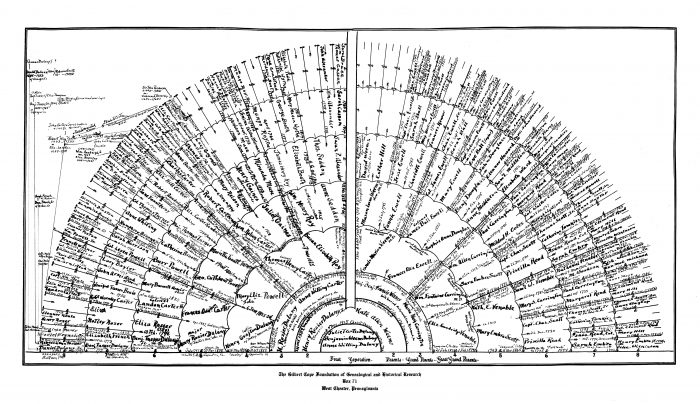
My 3x great-grandparents, Mary Eliza “Ida” Powell and Henry Grafton “Hal” Dulany, owned a plantation called Oakley in Fauquier County, Virginia starting in the 1850s. From then until the end of the Civil War, my ancestors enslaved dozens of men, women, and children there. The goals of this project are to trace everyone who was enslaved, find their ancestors, and their descendants. I have been and will continue to share my research with any living descendants and the communites in and around Fauquier County, Virginia.
I have already written a few blog posts about my Dulany ancestors and the people they enslaved. Please see those posts for more information. Of course, I hope to see you virtually on Oct. 25 so you can hear all about this project and the people connected with it. If you miss the live event, you can watch the video on AAHA’s YouTube channel: https://www.youtube.com/channel/UCX_TLihoYqd4-ErUQYxvuOw.
If you have read some of my other blog posts, you know that I am interested in giving a voice to the people enslaved by my ancestors. I have the advantage of either already having family papers or easily locating manuscript collections dealing with my ancestors since I know their names an where they lived. The tough part sometimes is finding the pieces of paper that list enslaved people by name. Before the pandemic in 2019, I found a source related to some of my Carter ancestors in Virginia, which lists enslaved people by name and connects them to a specific time and place.
In July 2019, I spent a few days researching in the library of the Virginia Museum of History & Culture (VMHC), formerly the Virginia Historical Society, in Richmond, Virginia. To maximize my time, I took digital photos of the items I requested, thinking I would go through the photos at a later date. Two years later…I still haven’t read through most of them, but I remembered that a plantation account book of one of my Carter ancestors had tons of great genealogical information on the enslaved and formerly enslaved who worked on the plantation. It is very possible that many of the names and relationships in this account book cannot be found in other records. I wanted to share some of the photos I took of the account book, but due to copyright, I am not allowed to publish them here without paying VHMC a small fortune. So, I did the next best thing and I have started to transcribe the account book. This blog post is the first step.
Thomas Henry Carter
Thomas Henry Carter (1831–1908), one of my paternal third-great-grandfathers, owned Pampatike, a plantation in King William County, Virginia. Pampatike is located along the Pamunkey River, northeast of Richmond. The library at the VMHC has his account book, as well as many other Carter family papers. According to the account book, Thomas H. Carter, his half-brother, William Page Carter (1836–1913), and their father, Thomas Nelson Carter (1800–1883), decided to invest in land in Louisiana in the late 1850s. Of course, large tracts of land in the South means there will most likely be enslaved people used as the labor force. The Carters sent forty enslaved people to Louisiana from two different plantations in Virginia. As you will see below, twenty-three people were sent south from the plantation in King William County. The elder Carter sent seventeen enslaved people from Clarke County in the northern part of Virginia. My best educated guess, without further research, is that these seventeen people came from Annefield, which was a Carter plantation in Clarke County where this branch of the Carters lived during this time period.
The following is a transcription (exact copy) of the first few pages of the account book (excluding a couple torn pages with scribbles and notes dating from the 1880s):
Partial Transcription of Thomas Henry Carter’s Account Book[1]
[the following line is written sideways down the left column of the page with a large bracket around the next two entries]
Loaned by Robt Carter by a draft of W Jackson + Co N O.[18] to both of $3.000
Thomas H Carter paid of this
amount $1,500
William P Carter paid of this
amount $1,500___________
$13,333.33
To sum up the several amounts
invested up to this date
By Thomas Carter $15.777. 25
“ Thomas H. Carter $6.706 08 +$5.400 [last number written in pencil]
“ William P. Carter 5.615 02
[first part written in pencil] 33.49835 $28.098 . 35
5.400 [written in pencil]
[page 8]
Of this $28.098.35 $1694.19 was
taken from the portions of Thomas
H. Carter + William P. Carter
to pay the expenses of transporting
the negroes + other incidental
expenses in settling them includ-
-ing a deposit of $565.12 with
A. D. Kelly by William P. Carter.
By subtracting this $1694.19 from
the whole amount $28.098.35 the
actual amount invested in
land is – $26.404.16
Of this Thomas Carter
has invested in land – $15.777.25
which is all the money
yet advanced by him.
Thomas H. Carter has
invested in land 6.056.08
William P. Carter has
invested in land 4.570.83
26.40416
It will be seen from the above account
that William + myself have paid all
the expenses of transporting the negroes
of my father. In them we have no
interest + this sum of $1694.19 is now
due us by him.
Of the $1694.19
Thomas H Carter paid $650.00
William P. Carter “ 479.07
Placed on deposit by
William P. Carter at
A. D. Kelly + Co 565.12
Whole amount by William $104419
[page 9]
Thomas H Carter $650.00
William P. Carter $1044.19
$16.94.19
Thos H. Carter $12.106.08 [written in pencil lower on page]
[1] Thomas Henry Carter (1831-1908), “Account book, 1859-1888,” [464] p., unpaginated bound volume originally kept at “Pampatike,” King William County, Virginia, Mss5:3 C2468:1; Virginia Museum of History and Culture (VMHC), Richmond, Virginia. Thomas Henry Carter descended from the famous or infamous Robert “King” Carter (1663–1732), one of the largest landowners and enslavers in the early 1700s in the Colony of Virginia. Thomas was educated at the Virginia Military Institute (VMI), the University of Virginia (UVA), as well as Jefferson Medical College in Philadelphia. At the onset of the Civil War in 1861, he joined the Confederacy as a captain of an artillery unit. By the end of the war, he rose to the rank of colonel. Thomas H. Carter spent the postwar years managing his plantation. He also was a railroad commissioner for the state of Virginia and Proctor of UVA.
[2] Susan E. Roy is Susan Elizabeth Roy (1833–1902). She was born in Mathews County, Virginia at the Roy family plantation named Green Plains. Her parents were Anne Seddon (1808–1834) and William Henry Roy (1800–1859). She married Thomas Henry Carter in 1855.
[3] Ann S. Roy is Ann Seddon Roy (1831–1908), sister of Susan E. Roy. Ann married John Coles Rutherfoord and they lived in Goochland County, Virginia.
[4] It seems like all of the enslaved people sent to Louisiana were owned by Thomas Nelson Carter, the father. That makes me wonder what the exact financial arrangement was when his son, Thomas Henry Carter, lived there.
[5] Pampatike was a Carter plantation in King William County, Virginia. Thomas Henry Carter, his wife, and children lived there for many years. Thomas Nelson Carter also lived there prior, however, I am not sure when. Pampatike is located along the Pamunkey River, northeast of Richmond. Today, it is still a functioning farm although it is not still owned by the Carter family. The farm is on private property. For more information about the history of the land and farm, see: http://www.pampatike.org/
[6] The elder Carter sent seventeen enslaved people from Clarke County in the northern part of Virginia. My best educated guess is that these people came from Annefield, which was the Carter plantation in Clarke County where this branch of the Carters lived. For more information on this property, see the Virginia Department of Historic Resources webpage on Annefield: https://www.dhr.virginia.gov/historic-registers/021-0002/
[7] Thomas Nelson Carter (1800–1883) rarely used his middle name in documents. His parents were Mary Nelson (1774–1803) and Robert Carter (abt 1771–1805). Thomas first married Juliet Muse Gaines (1806–1831) and one of their sons being Thomas Henry Carter. After Juliet died, Thomas married Anne Willing Page (1815–1891) in 1835. One of their sons was William Pleasants Page Carter.
[8] William Pleasants Page Carter (1836–1913), son of Thomas Nelson Carter and half-brother of Thomas Henry Carter. For a time, William was in the same artillery unit as his half-brother. Fold3 (https://www.fold3.com/image/20/8401344 : viewed 17 September 2021), William P Carter (Capt. W. P. Carter’s Co., Light Artillery), Civil War Service Records (CMSR) – Confederate – Virginia. William was captured in May 1864 and would eventually be one of the “Immortal 600” Confederate POWs. See: https://en.wikipedia.org/wiki/Immortal_Six_Hundred .
[9] Possibly Malcolm Thomas Morrison (1831–aft 1900?). See: Bruce Gunn, “Gunn, George, Margaret, 09-18-2016,” Ancestry (https://www.ancestry.com/family-tree/person/tree/27811013/person/27581235463/facts : viewed 17 September 2021), Malcom Thomas “M.T.” Morrison -B1831/D aft 1900 – HINDS CO MS – son of Angus Morrison1797 and Catherine Watts- m Fannie Wyche [yes, this is really all in the name field].
[10] The land was probably in Madison County, Louisiana, based on newspaper advertisements for land for sale placed by M T Morrison “Land for Sale,” Vicksburg Daily Whig, 04 March 1858, page 2, col. 5; Newspapers.com (https://www.newspapers.com/image/228525393 : viewed 17 September 2021).
[11] Throughout the account book, periods and commas are used interchangeably when showing amounts of money.
[12] Edwin Wortham & Co. was a “Richmond grocer and commission merchant [company who] acted as an agent for the Carters in the purchase and sale of insurance, farm produce, and livestock.” Kenneth M. Stampp, ed., A Guide to the Microfilm Edition of RECORDS OF ANTE-BELLUM SOUTHERN PLANTATIONS FROM THE REVOLUTION THROUGH THE CIVIL WAR Selections from The Colonial Williamsburg Foundation Library, The Shirley Plantation Collection, 1650-1888, Series K, (University Publications of America: Bethesda, Maryland, 1993), 4; LexisNexis (http://www.lexisnexis.com/documents/academic/upa_cis/2462_AnteBellSouthPlanSerK.pdf : viewed 17 September 2021).
[13] I am not exactly sure what Baker Bros & Co did as an organization, although it apparently changed over the years.
[14] Probably Robert Carter (1827–1911), son of Thomas Nelson Carter and brother of Thomas Henry Carter. Robert Carter would later become a doctor and move to Philadelphia.
[15] As of 17 September 2021, no ship manifests have been located to record the journey of the forty enslaved persons sent to Louisiana from Virginia.
[16] Probably Alexander D Kelly (abt 1806–1870). “Alexander D Kelly obituary,” Times-Democrat (New Orleans, LA) 18 January 1870, page 6, col. 2; Newspapers.com (https://www.newspapers.com/image/226607810 : viewed 17 September 2021). This obituary states Mr. Kelly was from Fauquier County, Virginia, so this might be the possible connection to the Carter family.
[17] Possibly John Wickham (1825–1902), who married Thomas Henry Carter’s first cousin, Elizabeth Hill Carter, on 29 November 1859 at Shirley Plantation in Charles City County, Virginia.


 Too Many Ancestors, Too Little Time