A version of this blog post appeared in the Main Line Genealogy Club’s online newsletter, The Dispatch 3.5 January 2024
December 16, 2023 was the 250th anniversary of the famed Boston Tea Party. There were countless events leading up to and on the anniversary, mostly in Boston, but also around the world. These events were just a prelude of things to come as we celebrate the semiquincentennial of birth of the United States of America. I am proud to say that my fourth great-grandfather, Joseph Roby, had a small part to play in the founding of this country, including as a participant in the Boston Tea Party.
I grew up knowing that my paternal roots in this country went way back to New England, including to the Mayflower. I also knew that the Robys were emigrants from England to the Boston area in the mid-1600s. While I never heard any specific stories, the family story came down through the generations that my fourth great-grandfather, Joseph Roby (1753-1836), participated in the Boston Tea Party and fought in the Revolutionary War.
It was not until I was in a colonial American history class in college that I revisited my revolutionary ancestor. Dr. Dan Rolph, who was the reference librarian for the Historical Society of Pennsylvania (HSP) for many years, was my professor. He introduced me to manuscripts at HSP, including a letter written by my fifth great-grandfather, Joseph Roby (yes, another one), which was in their archives. He also showed me sources on the tea party and colonial America. Later, I went to the National Archives branch in Philadelphia, used microfilm for the first time, and found Joseph Roby’s service record from the Revolutionary War.
Over the years as I have become a better genealogist, I have delved deeper into Joseph Roby. One of my main research goals is to prove (or disprove) that he participated in the tea party. I contacted the Boston Tea Party Ships & Museum early this year because I saw that they had a brand-new descendants program, in partnership with the New England Historic Genealogical Society (NEHGS). I have not completed my application yet, but I do plan on it if I can confirm my ancestor’s involvement. The museum and NEHGS have concluded that Joseph Roby was a participant, but the genealogist in me needs to continue the reasonably exhaustive research.
There are only two documents which list Joseph Roby as a participant in the Boston Tea Party: an 1819 letter printed in the Niles Weekly Register and the book Tea Leaves: Being a Collection of Letters and Documents Relating to the Shipment of Tea to the American Colonies in 1773 By the East India Company by Francis S. Drake. The 1819 letter was written by Lewis R. M. Morse, a son of Anthony Morse. Lewis claims that his father and Joseph Roby “were the most active in destroying the tea.” He wrote the letter on June 22, 1819 from Hanover, New Hampshire, and states that Joseph Roby was currently living in that town. My ancestor’s whereabouts have been hard to trace, but he probably resided in Hanover, NH at that time. He ended up near Rochester, New York by the 1830s.
Tea Leaves was published in 1884. The first part of the book lists Boston Tea Party participants and what, if anything, is known about them. This is the entry for Joseph Roby on page CLIV (p. 154): “Resided in Prince Street, Boston, in 1807, but was living in Hanover, N.H., in 1817.” There are no citations for this information nor in any other entry. However, as documented in his Revolutionary War pension file, a few people testified that Joseph Roby lived in Hanover, NH around 1817–1819. The Prince Street address can also be confirmed by newspaper advertisements and other records.
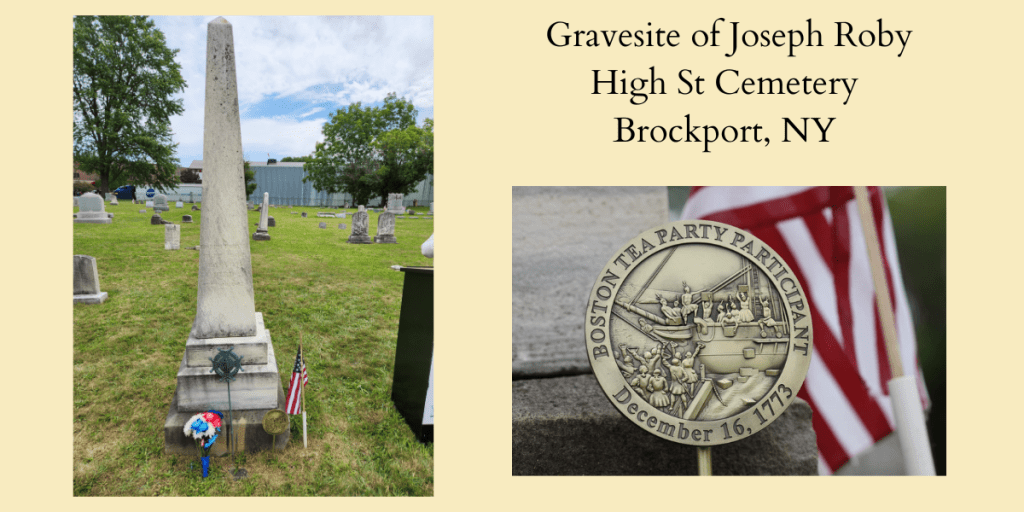
I was shocked in June 2023 to receive an email from my contact at the Boston Tea Party Ships & Museum. She said their group located many burial locations for Boston Tea Party participants, and they were placing markers on their graves throughout the rest of 2023 leading up to the anniversary. My ancestor’s grave is in Brockport, New York, over four hundred miles away from Boston. I could not pass up the opportunity to represent my family at this event.
On July 10, 2023, representatives from the Boston Tea Party Ships & Museum, Revolution 250, the towns of Brockport and Sweden, New York, and the local DAR and SAR chapters honored my fourth great-grandfather. It was a small, but nice ceremony and one which I won’t soon forget. I also felt drawn to attend because my grandfather, who was the first person to tell me about my family history, was instrumental in organizing a similar ceremony fifty years prior in 1973 on the 200th Anniversary of the Boston Tea Party.

I intend to keep researching Joseph Roby. I have been working on an article which I hope one of the major genealogical journals will publish. The focus is how I sorted out my Joseph Roby from all the other same named individuals in the Boston area. I was able to spend three extra days in Brockport and Rochester during my trip in July researching in local archives. Some of the information I uncovered should help with that future article. One of my resolutions for 2024 is to write more often on this blog, so if you want to read more about Joseph and my research, please sign up to receive updates.

 Too Many Ancestors, Too Little Time